
Thinking about this company, I am reminded of a Carl Icahn quote: “You gotta buy them when nobody wants them and sell them when everybody does.”
No one wants to buy this one, the stock is bombed out, and looks priced for bankruptcy, so we may have found an opportunity.
Sportsman’s warehouse is a sporting goods chain with 147 stores in 32 states. Mostly concentrated in the Western United States. The company is a Delaware corporation headquartered in Salt Lake City, Utah.
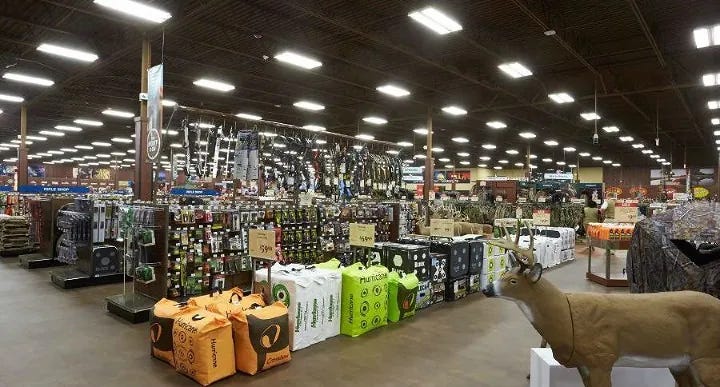
Stores are significantly smaller (37,000 sq ft) than Cabelas or other big box stores. An average store does around $8mn in sales a year. A typical store looks like this:
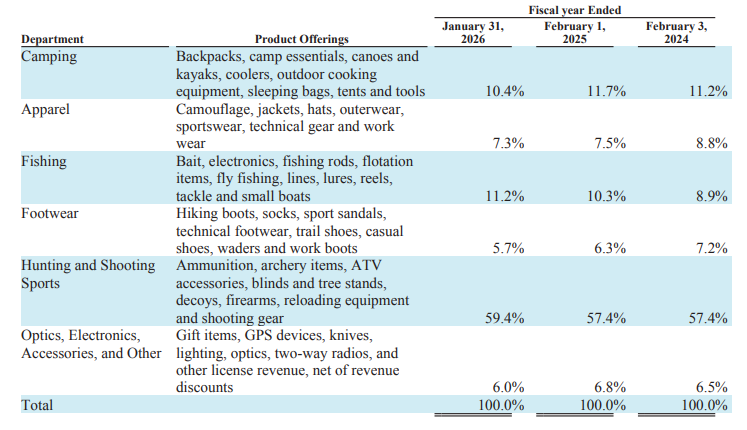
The breakdown of sales categories is:
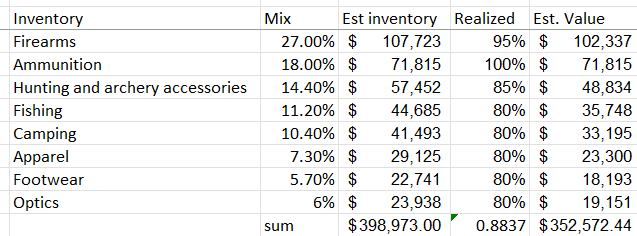
An estimate of inventory amounts is:
The general business is based on everyday low prices for ammunition and firearms (which are low margin, but attract foot traffic) with higher margins on accessories, apparel, camping and fishing products.
The general idea is that customers legally have to come into the store to purchase low cost firearms and ammunition, and while there they add other more profitable items to their cart. As I recall my shopping experiences for hunting and shooting products, I follow that pattern. Forgetting to buy new boots or gloves until I am there in the store picking up ammunition and a hunting license.
In late 2020, the chain had an offer to be acquired at $18/share by Great Outdoor’s Group (Bass Pro and Cabela’s). This offer fell apart on anti-trust grounds.
The company benefitted greatly from a covid boom in outdoor activities, and set record profits. With its profits it expanded aggressively. In retrospect they overbuilt locations and inventory and ran into operational issues.
This write up did a very good job on the company. It seems it was a one hit wonder, but consider subscribing to him. He points out that the chain has lower prices than competitors, and some adrdent fans in the outdoorsman community. He points out that new CEO Paul Stone visited every store location after he took the job. He also highlights that his scuttlebut found that ”when BPS was in the process of merging with SW, BPS bought all the inventory for all the stores. When the merger fell, SW was stuck without inventory, and basically had to buy whatever inventory they could, with the supply chain crisis during covid, I can imagine what a merchandise crisis SW was in.”
It seems that the CEO’s efforts are paying off. Inventory appears to be rightsized, core inventory sell-downs in camping and apparel are complete, and in-stocks (50 to 80%) are greatly improved.
“We have spent the last couple of years selling down inventory in camping, apparel, footwear and even firearms where we did not have the right assortment or were carrying aged merchandise that was tying up much needed working capital dollars.…We believe the SKU reduction initiative is now largely behind us, and we are confident we have the right go forward assortment to grow the business” - CEO
With same store sales (SSS) declining through 2026. SSS have now now turned positive, driven by growth in the hunting and shooting category, with limited sales growth in the other categories.
Today, the company is priced for bankruptcy, but it is not close to tripping any covenants on its asset based facilities, has no maturities until 2031 and lenders have historically been very flexible. Downside is also significantly protected by the value of its inventory. When considering similar retailers bankruptcy proceedings, this type of inventory appears to retain value very well in a liquidation.
Let’s consider the downside.
In an orderly liquidation, I think that the company can be liquidated for $1/ share. That is largely based on an analysis of their inventory position and what bankruptcy peers received historically (Gander Mountain, etc.)
The company’s debt is asset backed, and contains no major covenants. The most significant covenant is that they have to maintain the 10% on their gross borrowings base (mostly inventory), or $30mn. Currently this at its seasonal high water mark as inventory is built up for the second half of the year, and they have $73mn in available borrowing before tripping this covenant.
These credit agreements have maturities that have been pushed out to 2031:
As announced on June 18, 2026.
The A&R term loan…”The A&R Term Loan Agreement amends the Prior Term Loan Agreement to, among other things, extend the stated maturity date to June 18, 2031, representing a five-year term from closing of the A&R Term Loan Agreement, and provide that the applicable margin for borrowings under the A&R Term Loan Agreement will be either 4.00% or 7.00% depending on the type of term loan.
The senior secured facility… “On June 18, 2026, SWI, as lead borrower, the Company, as guarantor, and other subsidiaries of the Company, each as borrowers, and Wells Fargo Bank, National Association (“Wells Fargo”), as administrative agent, collateral agent, swing line lender, letter of credit issuer and lender, with a consortium of banks led by Wells Fargo, entered into a Third Amendment to Amended and Restated Credit Agreement and First Amendment to Third Amended and Restated Security Agreement (the “Credit and Security Agreement Amendment”) to amend (i) through Annex A to the Third Amendment (the “Amended Credit Agreement”), that certain Amended and Restated Credit Agreement, dated as of May 23, 2018, as amended May 17, 2022, July 30, 2024, and June 18, 2026 by and among SWI, as lead borrower, and Wells Fargo, as agent and a lender, and the other parties listed on the signature pages thereto (the “Prior Credit Agreement”) and (ii) that certain Third Amended and Restated Security Agreement, dated as of July 30, 2024, by and among SWI, the Company and the other borrowers and guarantors, and Wells Fargo (the “Prior Security Agreement”).
The Amended Credit Agreement provides for a senior secured revolving credit facility (the “Revolving Line of Credit”) in an aggregate principal amount of $315,000,000, which represents a reduction from the prior $350,000,000 commitment. The Revolving Line of Credit has a maturity of June 18, 2031, representing a five-year term from closing of the Credit and Security Agreement Amendment. The reduction in the commitment size was implemented, among other reasons, to align the size of the facility with the Company’s operating needs.”
Source: https://www.sec.gov/Archives/edgar/data/1132105/000119312526281135/spwh-20260618.htm
Terms of their accounts payable have also been steady. Suppliers are not demanding tighter payable terms, so they don’t appear to be viewing the company as a potential bankruptcy.
On the upside, the business was able to do $63mn in EBITDA pre-covid on 92 stores. On 140 stores, I estimate it can do $75mn in EBITDA, After $25mn in maintenance capex, and considering that the company has significant NOLS (roughly $85mn of federal deduction capacity, all indefinite-lived, ) normalized unlevered FCF should be $50mn. Capitalized at 12.5%, less debt, we get to a price target of $4.92 a share.
Put another way, today we are paying $212mn for an enterprise that can do $50mn in FCF, or 4.25x.
Also consider that SPWH’s big quarter is the gun season. Their net debt should be $60mn at the end of that quarter.
If you value it with the balance sheet position at the end of the fiscal year. That is an EV of $105mn on a business that should be able to do $50mn in normalized FCF.
How do we get back to normalized earnings?
1. Recovery in gun and ammo sales off a historic low.

Firearms businesses have had a difficult 3-4 years, recovering from a COVID hangover. Sales typically spike in an election year, so in 2028 I expect gun sales to rise significantly. As these sales increase, foot traffic and same store sales flow through a business with significant operating leverage.
2. Improving bundling and loyalty programs.
The company makes most of its margins off bundled products. As sales have shifted online, so has the psychology. Customers can now order and pay online and pick up in store. This locks in their purchase on the core low margin products before they enter the store. It is psychologically harder to add in additional purchases after you have already paid, as opposed to on the way to the register.
The company has reworked the website to better improve the ecommerce experience to encourage bundling.
The current CEO also came from Cabela’s and is revamping their loyalty program to better encourage repeat purchases and higher order values.
Pay off of inventory improvement efforts
As highlighted above, the company is working through their excess (and seemingly bad) inventory. They have made great progress on liquidating the poor quality inventory so far. Liquidating poor inventory depresses financial results. Often you have to be promotional to move it and make shelf space for better products.
And when it retail, it comes down to “do you have stuff people want at a price they want?” In recent history, the company has not had that, but is working hard to turn that around.
Risks:
1. Same store sales have leveled out, but gross margin has decreased. The risk is that this continues, and the company improved SSS by “buying” it with excessive discounting. This doesn’t appear to be the case in Q2, but it may happen in the future.
2. Management has found some cost savings by reducing SG&A. If they are firing their best salespeople in order to find cost savings, that will be bad in the long run. I don’t think this what they are doing, but it is a risk.
3. If customer behavior has shifted so much that they are only buying low margin products at the stores and buying the high margin items elsewhere, then the company will not benefit as much as they have historically from better demand in hunting and shooting. This is my biggest concern.
4. The company has significant debt and no owned real estate.
Summary
In summary, SPWH has downside protection (-17%) and significant upside (+300%). The company needs to continue to be cash flow neutral until the gun cycle turns, and they have until 2031 for that to happen. They have the runway, and management is good taking reasonable steps to be positioned well for improvements in demand. This is not the “cleanest” turnaround story, and there are inherent risks in this investment, but the risk-reward is so asymmetric that I find it compelling here.
Price Target: $4.92
Downside: $1.00
Price at Publication: $1.16 on 9/14/2026
Disclaimer: The information provided in this publication is for informational and educational purposes only and should not be construed as investment advice, financial advice, or a recommendation to buy or sell any securities. I am not a licensed financial advisor, and the views expressed are solely my own. Any investment decisions you make are at your own risk. Always do your own due diligence or consult a licensed financial advisor before making any financial decisions. Past performance is not indicative of future results.
This is how a stock idea is written. Well done!
It looks like the line of credit matures in 2027. I haven’t done a deep dive on this one and it could very well play out nicely but there are some significant risks here.